
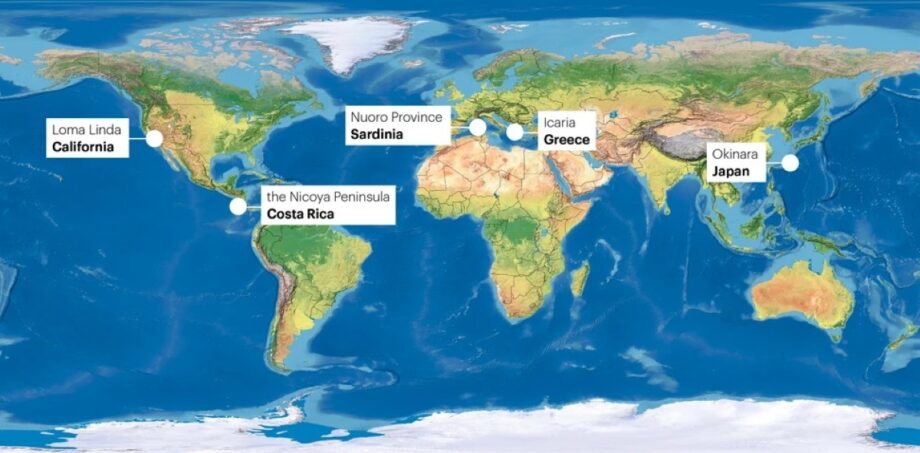
Blue Zones are specific, demographically confirmed geographic regions around the world where people live significantly longer and healthier lives than the average population, often reaching the age of 100 or more with low rates of chronic diseases like heart disease, cancer, and dementia.
The term was coined by National Geographic Fellow and journalist Dan Buettner, who, with a team of researchers, identified five original Blue Zones across the globe:
- Okinawa, Japan (home to some of the world’s longest-lived women)
- Sardinia, Italy (specifically the Nuoro province’s mountain region, known for the highest concentration of male centenarians)
- Nicoya Peninsula, Costa Rica
- Ikaria, Greece (an island with very low rates of middle-age mortality and dementia)
- Loma Linda, California, USA (home to a community of Seventh-day Adventists)
The key insight from the Blue Zones research is that the residents’ longevity is not primarily due to genetics, but rather a combination of shared, embedded lifestyle habits and environmental factors, which Buettner consolidated into the “Power 9” principles. These principles include natural daily movement, a predominantly plant-based diet (heavy on beans), having a strong sense of purpose, prioritizing family and social connections, incorporating stress-relieving rituals, and drinking alcohol moderately (except the Loma Linda Adventists). The local environment naturally nudges people into making these healthy choices without conscious effort.
Each of the “Power 9” Principles
These “Power 9” principles are nine common lifestyle characteristics observed in all five original Blue Zones that contribute to the residents’ exceptional longevity and health. They are a framework for making healthy choices unavoidable in your environment.
Here is an expansion on each principle:
- Move Naturally: People in Blue Zones don’t necessarily engage in structured exercise, like running marathons or joining gyms. Instead, their environments prompt constant, low-intensity physical activity. This involves activities like growing a garden, walking to the market, and doing household chores manually (e.g., house and yard work without mechanical conveniences).
- Purpose: The Okinawans call it “ikigai” and the Nicoyans call it “plan de vida” (plan for life). Having a clear sense of purpose—knowing why you wake up in the morning—is consistently linked to an increase in life expectancy by up to seven years.
- Down Shift: Even centenarians experience stress, which causes chronic inflammation linked to all major age-related diseases. The key is that they have daily routines to shed that stress. Okinawans take a few moments each day to remember their ancestors, Adventists pray, Ikarians take a nap, and Sardinians do a happy hour.
- The 80% Rule: This dietary guideline comes from a 2,500-year-old Okinawan mantra, “hara hachi bu,” which reminds them to stop eating when their stomachs are 80% full. This 20% gap is key to preventing weight gain and overeating, as it takes time for the brain to register fullness.
- Plant Slant: The cornerstone of the diet in all Blue Zones is primarily plant-based, with beans (fava, black, soy, and lentils) as a staple. Meat is consumed rarely, used more as a side or a condiment rather than the main course, and typically not more than twice a week in small portions.
- Wine @ 5: Moderate, regular alcohol consumption is common in most Blue Zones (Loma Linda, CA, is the exception). Moderate drinkers tend to outlive non-drinkers, with the consumption usually involving 1-2 glasses of wine daily, often with food and friends.
- Belong: Most centenarians are part of a faith-based community. Research suggests that attending faith services four times a month can add four to 14 years of extra life expectancy, regardless of denomination.
- Loved Ones First: Strong family ties are fundamental. Successful centenarians put their families first by keeping aging parents and grandparents nearby (or in the home), committing to a life partner, and investing time in their children.
- Right Tribe: The world’s longest-lived people create social circles that support healthy behaviors. Their social networks “nudge” them into making healthy choices, making the healthy lifestyle not only easy, but sustainable over the long term.
These principles highlight that health and longevity are deeply intertwined with community, environment, and outlook, not just individual willpower.
Common Misconceptions about Aging and Health Challenged by Blue Zones
The Blue Zones challenge several common misconceptions about aging by demonstrating the profound impact of lifestyle and environment over genetics and modern “longevity hacks”.
Common Misconceptions vs. Blue Zones Reality
| Misconception | Blue Zones Challenge/Reality |
| Aging inevitably means poor health and chronic disease. | People in Blue Zones maintain high levels of vitality and low rates of chronic diseases (like heart disease, cancer, and dementia) well into their late years, though they are not immune to all health issues. The quality of life is extended along with the length. |
| Genetics are the primary determinant of lifespan. | While genes play a role (estimated around 20-25% for reaching age 100), lifestyle and environment are far more impactful in Blue Zones. The same “longevity genes” aren’t consistently found across all zones. |
| Extreme, structured exercise is essential for longevity. | Blue Zone residents don’t run marathons or join gyms. Instead, they incorporate natural, consistent movement (gardening, walking, manual labor) into their daily lives without conscious effort, challenging the idea that intense fitness routines are necessary. |
| Special supplements and diets are the key to aging well. | Centenarians in Blue Zones don’t rely on supplements or “longevity hacks”. Their diets are generally simple, plant-based (heavy on beans), and integrated into a broader lifestyle that includes strong social ties and a sense of purpose. |
| Retirement and taking it easy are best for old age. | The concept of “purpose” (or ikigai in Okinawa) is vital. People in Blue Zones often remain active contributors to their communities and families throughout their entire lives, showing that a lack of purpose can actually shorten lifespan. |
| Social connection is a secondary health factor. | Strong social bonds and tight-knit communities (Right Tribe, Loved Ones First) are core to Blue Zone life and a critical component of healthy aging, challenging the Western emphasis on individual self-reliance. |
The main takeaway is that longevity in the Blue Zones stems from creating an environment that encourages healthy habits naturally, rather than relying on individual willpower, expensive interventions, or a lucky genetic roll.
What Criticisms do Researchers Have about the Blue Zones?
Researchers have raised several criticisms about the Blue Zones concept, focusing primarily on the reliability of the underlying demographic data and the methodology used to identify these areas.
Key criticisms include:
- Inaccurate Age Records and Data Quality: The most significant criticism comes from researchers like Saul Justin Newman, who argue that the high concentration of centenarians in some Blue Zones is an artifact of poor historical record-keeping, a lack of standardized birth certificates, and clerical errors. In regions that were historically poorer or had lower literacy rates, age exaggeration for social status or even pension fraud may have inflated the numbers of people claiming to be over 100 years old. A 2010 Japanese government review, for example, found that many registered Okinawan centenarians were actually deceased, highlighting potential issues with death registration.
- Correlation vs. Causation: Critics point out that even if people in these areas live long lives and share certain habits, it is difficult to scientifically prove that those specific “Power 9” habits are the direct cause of their longevity. The observed lifestyles might just be correlated with longevity, while other unmeasured genetic, environmental, or socioeconomic factors could be the true drivers.
- Generalizability of Findings: Some argue that the unique cultural and geographic contexts of the Blue Zones make their lessons difficult to apply universally in modern, urbanized Western societies. For instance, a close-knit community in rural Sardinia is challenging to recreate in a major city.
- Commercialization and Selection Bias: The Blue Zones concept has evolved into a significant commercial brand with books, products, and consulting services, leading some critics to suggest that marketing objectives might influence the selection and presentation of the “science” behind the zones. Some researchers claim that data supporting the lifestyle claims (like diet in Okinawa) contradict independent government surveys for the same regions.
Proponents of the Blue Zones concept, including co-originator Michel Poulain and Dan Buettner, counter these arguments by emphasizing their rigorous age validation procedures using multiple sources (birth records, church archives, genealogical reconstructions) and argue that the lifestyle principles remain a valuable model for public health.
However, understanding these criticisms can help provide a balanced view of the Blue Zones phenomenon.
Evidence-based Longevity Research from Another Scientific Source
Evidence-based longevity research from the National Institute on Aging (NIA) emphasizes the significant impact of controllable lifestyle factors on extending both lifespan and “healthspan” (years lived free of major chronic disease).
The NIA synthesizes findings from large-scale, long-term studies, identifying several key areas critical for healthy aging:
Key Evidence-Based Factors for Longevity
- Physical Activity is a Cornerstone: Regular physical activity is a core tenet of healthy aging. Scientific evidence suggests consistent exercise not only helps people live longer but also improves quality of life by reducing the risk of conditions like heart disease, diabetes, certain cancers, and cognitive decline.
- Recommendation: Aim for at least 150 minutes of moderate-to-vigorous physical activity each week.
- Healthy Diet is Crucial: The NIA highlights eating patterns that are nutrient-dense and primarily plant-based. The Mediterranean diet and the MIND diet (a hybrid of the Mediterranean and DASH diets) have been particularly associated with improved cognitive function and lower risks of heart disease and stroke.
- Recommendation: Focus on fruits, vegetables, whole grains, and healthy fats, while limiting red/processed meats, sugary drinks, and excess sodium.
- Maintain a Healthy Weight: Maintaining a normal weight (BMI between 18.5 and 24.9) is associated with substantially lower risks of chronic diseases and increased life expectancy.
- Prioritize Quality Sleep: Getting enough consistent, quality sleep (7-9 hours for adults) is essential for mood regulation, cognitive function, and lowering the risk of conditions like insulin resistance, heart disease, and dementia.
- Manage Stress and Mental Health: Chronic stress causes inflammation and is linked to age-related diseases. The NIA emphasizes managing stress through various techniques and participating in enjoyable activities and social connections to support mental and emotional well-being.
- Strong Social Connections: Research using the Social Frailty Index shows that social factors are strong predictors of mortality risk for older adults. Staying connected with family and friends helps boost mood and overall well-being.
- Avoid Smoking and Limit Alcohol: Not smoking is one of the most impactful lifestyle choices for longevity; quitting at any age provides significant health benefits. Moderate alcohol intake (up to one drink per day for women, two for men) is linked to better outcomes than heavy drinking or abstaining.
- Regular Medical Care: Consistent check-ups and health screenings are vital for early detection and management of age-related conditions like high blood pressure and cholesterol.
These factors, strongly supported by long-term NIH-funded research like the Nurses’ Health Study, emphasize that substantial longevity benefits come from combining multiple healthy habits throughout life.
What Can We Conclude
Longevity research from various sources, including the National Institute on Aging (NIA) and the Blue Zones project, converges on a central theme: while genetics play a minor role, lifestyle and environmental choices are the primary drivers of healthspan and lifespan.
Key Themes for Longevity
- Lifestyle as the Foundation: All sources emphasize that daily habits have more impact than “longevity hacks” or extreme measures. The Blue Zones show that a life of natural movement, purpose, and community support health outcomes far better than sedentary living.
- Plant-Based Nutrition: Dietary recommendations consistently favor plant-forward diets. The Blue Zones follow a “Plant Slant” approach, the NIA endorses the Mediterranean and MIND diets, and even “The 100 Year Lifestyle” philosophy promotes healthy eating patterns. The focus is on whole foods, moderation (the 80% rule), and minimizing processed foods and excess meat.
- Holistic Health: Longevity is not just physical health. Strong social connections, a clear sense of purpose (ikigai), stress management (“Down Shift”), and community belonging are all considered vital for long-term well-being and are strongly supported by both ethnographic Blue Zones research and large-scale NIA studies.
- Integrated Physical Activity: The most effective physical activity is consistent and integrated into daily life, rather than confined to a gym schedule. Walking, gardening, and manual labor are universal practices among centenarians.
- Evidence vs. Misconception: The most robust, peer-reviewed evidence from the NIA and validated research confirms that the fundamental lifestyle factors (diet, exercise, social ties) are the most reliable path to healthy aging.
In conclusion, living a long, healthy life is less about finding a single secret bullet and more about consistently implementing a comprehensive set of simple, integrated lifestyle habits throughout one’s life.